

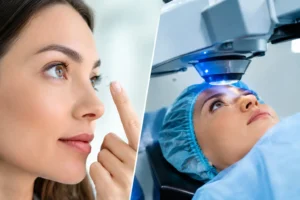
If you like the idea of clear daytime vision without glasses or daytime contact lenses, ortho k lenses UK patients ask about are often worth a closer look. They are not a quick online purchase or a one-size-fits-all option. Done properly, they are a carefully fitted treatment that reshapes the front surface of the eye overnight, so you can see clearly during the day.
For some people, that sounds almost too good to be true. For others, especially parents of short-sighted children or adults who are active, sporty, or simply tired of juggling specs and lenses, it can be a genuinely useful alternative. The key is understanding where ortho-k works well, where it has limits, and why expert fitting matters.
What are ortho k lenses?
Orthokeratology, usually shortened to ortho-k, uses specially designed rigid contact lenses worn while you sleep. These lenses gently change the shape of the cornea overnight. In the morning, you remove them and, for many patients, vision remains clear throughout the day without needing glasses or contact lenses.
The effect is temporary, so the lenses need to be worn regularly to maintain the result. That temporary nature is part of the appeal for some patients. Unlike laser eye surgery, ortho-k does not permanently alter the eye. If you stop wearing the lenses, the cornea gradually returns to its usual shape.
That said, temporary does not mean casual. These are medical devices that need precise fitting, good hygiene, and regular follow-up care.
Why ortho k lenses UK patients choose them
In practice, people tend to consider ortho-k for a few clear reasons. The first is freedom during the day. If you play sport, work in dry or dusty environments, spend long hours on screens, or simply dislike wearing specs, waking up with corrected vision can be very appealing.
For children and teenagers, another reason often comes into the conversation – myopia management. Myopia, or short-sightedness, is becoming more common, and higher levels of myopia can increase the long-term risk of certain eye health problems. Ortho-k is one of the approaches used to help slow myopia progression in suitable children.
Parents often like the fact that children are not relying on lenses during school hours or while playing football, swimming, or running around. Of course, children still need to be mature enough, with support from parents, to manage lens care safely.
Adults usually come at it from a different angle. Some want a non-surgical alternative to laser vision correction. Others have found soft contact lenses uncomfortable by the end of the day, particularly if they already struggle with dryness. And some simply want to see clearly at the gym, on walks, or when driving without reaching for glasses first thing.
How well does ortho-k work?
For the right prescription, ortho-k can work very well. It is most commonly used for mild to moderate myopia, sometimes with a degree of astigmatism. Results depend on the shape of the cornea, the prescription, tear quality, eyelid anatomy, and how consistently the lenses are worn.
This is where honest advice matters. Not everybody is a good candidate, and it is far better to know that early than to press on with a treatment that may not give reliable results. Some patients achieve crisp all-day vision quickly. Others may need a little longer for the effect to settle, or may still need occasional spectacles for specific tasks.
There can also be trade-offs. Night vision symptoms such as haloes or glare may occur, particularly in the early stages or in certain prescriptions. Many patients adapt well, but it is something that should be discussed properly rather than glossed over.
Who is suitable for ortho k lenses in the UK?
A proper assessment is essential before deciding. In general, suitable patients are those with healthy eyes, a prescription within an appropriate range, and the ability to follow lens care instructions carefully.
Children may be suitable if there is concern about progressing myopia and if parents are happy to be involved with cleaning, insertion, removal, and follow-up visits. Adults may be suitable if they want daytime freedom from glasses and lenses without surgery, or if their lifestyle makes daytime contact lens wear inconvenient.
There are also times when ortho-k may not be the best option. Significant dry eye, certain corneal conditions, poor hygiene habits, unrealistic expectations, or prescriptions outside the effective range can all make another solution more sensible. That is not a failure – it is simply part of matching the right treatment to the right person.
What the fitting process involves
When people first look into ortho k lenses UK clinics provide, they are often surprised by how detailed the fitting process is. That is actually reassuring. These lenses are highly individual, and the fitting is based on careful measurements of your eyes rather than a standard prescription alone.
A full consultation usually includes a detailed eye examination, discussion of your visual needs, corneal topography to map the shape of the eye, and an assessment of tear film and eye health. If ortho-k looks suitable, trial fitting and follow-up appointments are then used to refine the lens design and monitor the treatment effect.
After the first night or first few nights of wear, reviews are important. The practitioner checks how the cornea is responding, whether the fit is centred properly, and how well your vision is improving. Ongoing aftercare remains a key part of treatment, not an optional extra.
At an independent practice, this is often where patients feel the difference. There is time to answer questions properly, explain what is normal, and support you through the adaptation period rather than rushing you through a standard process.
Cost, value and what you are really paying for
One of the first questions people ask is cost. Ortho-k is usually more expensive upfront than standard soft contact lenses because you are paying for specialist assessment, bespoke lens design, advanced measurements, and regular aftercare.
It helps to think about value rather than headline price alone. You are not simply buying lenses. You are paying for a clinical service, close monitoring, and expertise in a treatment that needs precision. If ortho-k is being considered for a child as part of myopia management, the longer-term value can be particularly relevant.
Costs vary between practices and according to complexity, replacement schedules, and aftercare arrangements. It is always worth asking what is included so you can compare like with like.
Safety and lens care
Ortho-k can be safe when properly fitted and cared for, but it is not maintenance-free. Because the lenses are worn overnight, hygiene matters enormously. Hands must be washed carefully, cleaning routines followed exactly, and review appointments kept.
Any overnight lens wear carries a risk of infection, and that risk rises if care instructions are ignored. Redness, pain, light sensitivity, or reduced vision should always be checked promptly. Patients and parents should feel comfortable asking questions and reporting concerns early.
This is one area where clear guidance and continuity of care really matter. You want to know who is looking after your eyes and to feel that support is there if something does not seem right.
Ortho-k compared with glasses, soft lenses and laser surgery
Glasses are still the simplest solution for many people. They are low risk, easy to manage, and give reliable vision correction. Soft contact lenses can also be excellent, especially for occasional or flexible wear. Laser surgery may suit adults who want a permanent option and are suitable candidates.
Ortho-k sits in the middle in an interesting way. It offers daytime freedom without surgery, and for children it may also support myopia control. The trade-off is that it requires commitment, precise fitting, and consistent aftercare. Some patients love that balance. Others decide a simpler option suits them better.
That is why a thoughtful conversation is more useful than a hard sell. The best choice depends on your eyes, your routine, your budget, and how comfortable you are with the care involved.
Finding the right support
If you are considering ortho-k, choose a practice that takes time over both assessment and aftercare. This is not something to approach as a bargain purchase. Experience, careful measurements, and ongoing review all count.
For families in Northamptonshire, this is often where a long-established independent practice can make a real difference. At Mark Darling Eyecare & Opticians, we know many patients want more than a quick appointment and a standard answer. They want clear advice, honest guidance, and care that is tailored to them.
If ortho-k is right for you or your child, it can be a very practical and rewarding option. If it is not, a good practitioner should be just as confident in saying so. The right vision solution is the one that fits your life as well as your eyes.