

A ball can change direction in a fraction of a second. A racquet, elbow or finger can be closer than expected. When you wear glasses, choosing the right sports eyewear is not simply about seeing the action clearly – it is about protecting your eyes without creating another distraction.
Knowing how to choose sports goggles means looking beyond the frame colour or whether they seem comfortable for a minute in the mirror. The right pair should suit the sport, stay secure when you move, work with your prescription where needed, and provide meaningful protection for your eyes.
Start with the sport, not the frame
Different activities create different risks. For racket sports, squash in particular, fast-moving balls and close contact make eye protection a sensible precaution for players of all ages. For football, hockey and basketball, the priorities may be impact resistance, stability and a design that does not slip during quick changes of direction. Cycling and outdoor running call for protection from wind, insects, dust and bright light, while swimming requires a secure seal and clear vision in water.
A general pair of sunglasses is not automatically suitable for sport. Ordinary frames can shift, break or leave too much of the eye area exposed. Proper sports goggles are designed to stay in place and provide coverage around the eyes. For higher-risk sports, choose eyewear made specifically for that activity rather than relying on everyday spectacles.
It is also worth checking the rules at your club, school or competition. Some sports have their own requirements for protective eyewear, particularly for junior players. A well-intentioned purchase is no use if it is not permitted on court or on the pitch.
Choose lenses that protect as well as correct
The lens material is one of the most important decisions. For most active sports, impact-resistant polycarbonate lenses are a popular choice because they are lightweight and more resistant to shattering than standard ophthalmic lenses. They can be especially useful for children, who may be less cautious about where their goggles are placed between games.
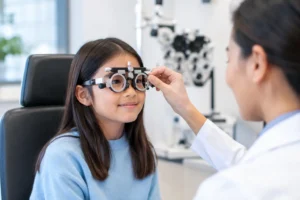
If you need a prescription, sports goggles can often be glazed to match it. This can make a considerable difference to confidence and performance: judging distance, tracking a ball and reading changes in terrain are all harder when your vision is blurred. Bring your current prescription to your appointment, but do not assume it is still the right one. An up-to-date eye examination is the best starting point, particularly if you have noticed headaches, eye strain or difficulty seeing clearly in low light.
Lens tints deserve some thought too. Clear lenses are usually best for indoor sports and evening sessions. A sun tint may be useful outdoors, but the ideal depth and colour depend on the activity and the conditions. Grey tints reduce brightness without changing colours too much, while contrast-enhancing tints can help some people pick out details in variable light. There is no single best option for everyone.
For cycling, running and water sports, a UV filter is valuable when you are outdoors. Polarised lenses can reduce reflected glare from water, wet roads and other flat surfaces, although they are not right for every activity. Some people find that certain digital displays are harder to read through polarised lenses, so consider how and where you train.
How to choose sports goggles for a secure fit
Even excellent lenses cannot do their job properly if the goggles move every time you run or look down. Sports goggles should feel secure but never painfully tight. A good fit spreads pressure evenly around the face, with soft padding where the frame sits against the brow and cheeks.
Try them while moving, not just while sitting still. Look up, down and side to side. Mimic a sprint, a jump or a tennis serve. The frame should not slide down your nose, pinch behind your ears or press uncomfortably on the bridge of your nose. An adjustable strap is often useful, particularly for children and for contact sports, because it keeps the goggles in position during sudden movement.
Coverage matters as well. A frame that sits too far from the face can leave gaps where dust, wind or a ball may reach the eye area. One that is too close may cause eyelashes to brush the lenses, leading to smudges and irritation. Ventilation is the balance to look for: enough airflow to reduce misting, without making the goggles feel exposed.
For younger wearers, fit is not something to compromise on in the hope they will grow into them. Goggles that are too large are less likely to be worn and less likely to protect effectively. Children are usually far more willing to use eyewear that feels comfortable, looks good and does not steam up halfway through a lesson.
Consider your prescription and everyday comfort
A stronger prescription, astigmatism or a multifocal prescription can affect which sports-goggle designs are most suitable. Curved, wraparound frames can offer excellent coverage, but they may need careful lens selection and accurate measurements to give comfortable vision. This is one reason a professional fitting is worthwhile rather than buying solely by prescription number online.
If you normally wear varifocals, think about what you need to see during the sport. A golfer may benefit from a different visual arrangement than a squash player, for example. For a fast-paced activity, many people prefer single-vision sports lenses set for the distance that matters most. There is a trade-off: a dedicated pair may not be as convenient off the court, but it can provide clearer, more natural vision while playing.
Contact lenses are another option for some people, often paired with non-prescription protective goggles. They can give a wide field of view and avoid the lens thickness associated with higher prescriptions. However, they are not ideal for every eye or every environment. Dry eye symptoms, allergy season and dusty conditions can all make contact lenses less comfortable. The best choice is the one that protects your eyes and remains comfortable for the full session.
Look for practical details that make a difference
Sports eyewear has to cope with sweat, rain, fingerprints and being thrown into a kit bag. Anti-fog coatings can be helpful, but they still need the right care. Avoid wiping dry lenses with a shirt or towel, as grit can scratch them. Rinse away dust where possible, then use a clean microfibre cloth and lens cleaner recommended for your eyewear.
It helps to ask about replacement parts before you buy. Straps, nose pads and lenses can wear over time, especially when goggles are used several times a week. Being able to replace a small part may extend the life of a pair that otherwise fits perfectly.
When comparing options, consider these four essentials:
- A sport-appropriate, impact-resistant frame and lens material
- A secure fit with stable, comfortable contact points
- Prescription accuracy and lens design suited to how you play
- Useful extras, such as anti-fog treatment, UV protection or an adjustable strap
The most expensive option is not automatically the best. The right choice depends on the level of risk, how often you play, whether you need prescription correction and how likely you are to wear the goggles consistently.
Do not wait until an injury to take eye protection seriously
Eye injuries in sport can range from a minor surface scratch to something requiring urgent assessment. If you are struck in or around the eye and have pain, reduced vision, double vision, increasing redness, flashes, floaters or sensitivity to light, seek prompt professional advice. Do not rub the eye or try to remove anything that appears embedded.
Prevention is simpler. Parents often buy shin pads, helmets and mouthguards without a second thought, yet eye protection can be overlooked until a near miss happens. A properly fitted pair of sports goggles is a practical part of the kit, particularly for sports involving balls, racquets, sticks or close contact.
At Mark Darling Eyecare & Opticians, we take the time to understand how you see, what you play and what gets in the way of comfortable eyewear. A careful fitting can help you find sports goggles that feel like part of your routine, rather than something you cannot wait to take off. The best pair is the one that gives you clear vision, stays put when the game gets lively and helps you focus on enjoying the sport.