
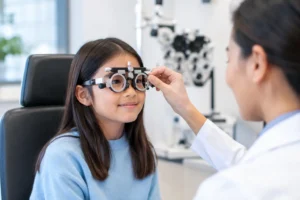


The first sign is often a small one: a child moving closer to the television, losing their place when copying from the board, or saying that distant signs look unclear. A myopia management case is not simply about supplying stronger glasses when this happens. It is about understanding why a child’s short-sightedness is changing, monitoring it carefully, and considering practical ways to slow its progression.
For parents, that can feel like a lot to take in. The reassuring news is that myopia management is a planned, individual process. It starts with taking the time to understand your child, their eyes and their everyday routine.
What a myopia management case can look like
Consider a typical example. A nine-year-old comes in after struggling to see the whiteboard at school. Their first pair of glasses brings clear, comfortable vision, but a year later their prescription has increased. One parent is short-sighted, the child enjoys reading and gaming, and much of their week is spent indoors between school, homework and activities.
None of those details alone tells us exactly how their myopia will develop. However, together they help build a useful clinical picture. A family history of myopia, an earlier age of onset and a prescription that changes over time can all be reasons to look more closely at myopia management.
At this stage, the aim is not to alarm parents or make promises that no clinician can honestly make. Every child is different, and some prescriptions change more quickly than others. The aim is to make informed choices early, while keeping a close eye on how the eyes are developing.
Why progression deserves attention
Myopia means that distant objects appear blurred because the eye focuses light in front of the retina rather than directly on it. In childhood, this often happens because the eye grows longer from front to back.
A low prescription may be straightforward to correct with glasses or contact lenses. But higher levels of myopia in later life are associated with a greater risk of certain eye-health conditions, including retinal problems, glaucoma and changes at the back of the eye. Slowing the rate at which myopia progresses during childhood may therefore have benefits that extend well beyond clearer sight in the classroom.
That is why routine eye examinations matter, even when a child seems to be managing well. Children do not always realise their vision has changed. They may adapt by sitting nearer the front, avoiding distance-based activities, or assuming that everyone sees the same way they do.
Looking beyond the prescription
A thorough appointment should never feel like a quick check of letters on a chart. We need to establish how well your child sees, assess the health of their eyes and compare their current prescription with previous results. Where appropriate, measurements of eye growth can also help us monitor change over time.
The conversation is equally valuable. We will ask about family history, school, hobbies, screen use and time outdoors. These questions are not about judging a family’s routine. They help us recommend an approach that is realistic enough to work in daily life.
For one child, glasses may be the best and simplest option. Another may be mature, motivated and comfortable with the idea of contact lenses. A child who swims or plays regular sport may value a solution that gives them clearer unaided vision during activities. Comfort, confidence, hygiene and parental support all matter just as much as the clinical findings.
Options for managing childhood myopia
There is no single treatment that suits every child. Depending on age, prescription, eye health and lifestyle, myopia management may involve specially designed spectacle lenses, specialist soft contact lenses, overnight contact lenses, or treatment in collaboration with other eye-care professionals where appropriate.
Specially designed myopia management spectacles can be a particularly good starting point for younger children or those who are not ready for contact lenses. They are worn much like ordinary glasses, but their optical design is intended to help manage the signals that can contribute to eye growth.
Specialist soft contact lenses can suit children who are responsible enough to follow cleaning and wearing advice. Many parents are understandably cautious at first, but with careful teaching, appropriate supervision and regular aftercare, contact lenses can be a practical option for some children. They can also be helpful for sport and other active hobbies.
Overnight lenses, sometimes known as orthokeratology lenses, reshape the front surface of the eye while the child sleeps. They are not suitable for everyone and require excellent hygiene, commitment and close follow-up. For the right patient, however, they may offer daytime freedom from glasses and lenses.
The best choice depends on the child in front of us, not on a one-size-fits-all recommendation. We will explain the benefits, limitations, costs and care requirements clearly, so you can decide with confidence.
Everyday habits still play a part
Clinical management works best alongside sensible visual habits. Spending more time outdoors is associated with a lower likelihood of children developing myopia, and it remains a positive part of a balanced routine for children who are already short-sighted. This does not mean every child needs to become a keen footballer or spend hours outside in poor weather. Walks, playing in the garden, cycling, trips to the park and outdoor family time all count.
Near work such as reading, drawing and using digital devices is part of modern childhood, and it is not helpful to treat screens as the sole cause of myopia. The more useful approach is balance. Encourage regular breaks, a comfortable viewing distance, good lighting and plenty of time away from close work.
A simple habit can help: after around 20 minutes of close work, look into the distance for a short while. It gives the eyes a break and can be easier to maintain when it becomes part of homework or gaming routines. Good sleep, time outdoors and regular eye examinations support the bigger picture too.
Monitoring is where the case develops
A myopia management case does not end when the first pair of glasses or lenses is collected. Follow-up appointments allow us to check vision, comfort, prescription changes and, where measured, eye growth. They also give children and parents the chance to ask questions as routines change.
A child who initially chooses spectacles may later become interested in contact lenses for secondary school or sport. Equally, a child may find that contact lenses are not right for them at a particular stage. Changing course is not a failure. Good eye care should adapt as a child grows, their confidence develops and their needs evolve.
Parents should let us know if glasses are no longer being worn, lenses feel uncomfortable, distance vision seems to be slipping, or headaches and squinting become more frequent. These signs do not always mean there is a serious problem, but they are worth checking rather than waiting for the next routine appointment.
Personal care makes a difference
When it comes to children’s eyes, continuity matters. Seeing the same practice over time means we can build a clearer picture of changes, remember what has worked well and support your family without rushing decisions. At Mark Darling Eyecare & Opticians, we take the time to see each child as an individual, combining careful assessment with practical advice that fits family life.
If your child has started to struggle with distant vision, or you have noticed their prescription changing, an eye examination is a sensible place to begin. A calm conversation now can help you understand the options and make a considered plan for the years ahead.