

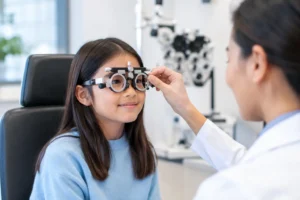

A child can be delighted by the colour of a frame, then refuse to wear it because it slips every time they look down. That is why knowing how to choose children’s frames means looking beyond the mirror. The right pair should support clear vision, feel comfortable through a busy school day and suit a child well enough that they are happy to put them on every morning.
For parents, there can be a lot to take in after an eye examination. Prescription, lens options, frame shapes and a child’s own strong opinions can all arrive at once. A carefully fitted pair of glasses is not simply an accessory: it is part of helping your child see, learn, play and feel confident.
Start with a proper fit, not a favourite colour
Children’s faces are still growing, and their features are proportioned differently from those of adults. A frame that looks appealing on the shelf may sit too low on the nose, rest against the cheeks or be too wide at the temples. These details matter because the lenses need to remain in the correct position in front of the eyes.
The bridge is a good place to begin. Many younger children have a small or less-defined nose bridge, so a frame needs enough support to stay in place without pinching. If glasses constantly slide down, your child may peer over the top of the lenses, push them up repeatedly or decide they are too much trouble to wear.
The frame should sit level, with the eyes centred naturally within the lens area. It should not touch the eyelashes, press uncomfortably behind the ears or rise when your child smiles. A good dispensing optician will check these points while your child moves, talks and looks in different directions, rather than judging the fit from one still moment.
How to choose children’s frames for everyday comfort
Comfort is one of the strongest predictors of whether glasses will actually be worn. Children are rarely patient with rubbing, pressure or frames that feel heavy, and they should not have to be.
Look for temples that follow the head comfortably without squeezing. Depending on your child’s age, activity level and the frame style, curled or cable temples can offer extra security behind the ears. Spring hinges may also be useful for some children, especially if they are prone to taking glasses on and off enthusiastically. They are not essential in every case, but they can give a little more flexibility.
Weight is worth considering too. A lighter frame can be more comfortable for all-day wear, particularly for a child with a stronger prescription, where lenses may add weight. However, light does not automatically mean flimsy. The best choice balances a manageable weight with a construction that can cope with ordinary childhood life.
It is sensible to ask your child how the frame feels, but do not rely on their answer alone. A younger child may choose the brightest option and say it is fine simply because they want it. Professional fitting helps uncover the practical issues they may not notice until an afternoon in the classroom.
Choose materials that match your child’s routine
There is no single best material for every child. The most suitable option depends on age, skin sensitivity, prescription, how glasses are used and how likely they are to be dropped, bent or used as part of an energetic game.
Plastic frames are popular for younger children because they can be light, colourful and available in shapes designed for smaller faces. Some offer a close, secure fit and are easy for little hands to manage. Metal frames can be a good choice for older children who prefer a more subtle look or need a particular fit adjustment. They often allow for precise shaping around the nose and ears.
For very active children, durability matters, but it is helpful to be realistic about what that means. No frame is indestructible, and a pair designed for school and daily life may not be the right protection for contact sports. If your child plays sports regularly, ask about sport-specific eyewear or protective options rather than expecting everyday glasses to do every job.
If there is a history of eczema, contact sensitivity or irritation around the nose and ears, mention it during the appointment. Small adjustments in material, finish or fitting can make a meaningful difference.
Let the prescription guide the frame choice
The prescription should influence the frame, particularly when it is stronger or more complex. A dispensing optician can explain which shapes and sizes will help keep lenses thinner, lighter and better positioned for your child’s vision.
In general, a frame that is not excessively large for the face can be helpful with stronger prescriptions. It keeps the lens area sensible and can reduce unnecessary lens thickness at the edges. This does not mean your child has to wear a tiny frame or miss out on a style they love. It means finding an option that gives them both good vision and a proportionate appearance.
The position of the pupil within the lens is equally important. Children look in every direction as they read, play, climb and learn, so accurate measurements and a stable fit are essential. This is one reason buying children’s glasses is more than choosing a frame online from a photograph. The frame, lenses and fitting work together.
For some prescriptions, specialised lenses may be recommended. Your optician should explain the reason in plain language, including what benefit they are expected to provide and whether they suit your child’s needs. The most expensive option is not automatically the right one; the right one is the lens choice that supports clear, comfortable vision in their normal day.
Involve your child in the decision
A child who likes their glasses is more likely to wear them. Once the practical fitting requirements have narrowed the choice, give them meaningful say over colour, shape and small details. For some children, that may mean a favourite colour. For others, it may mean finding a pair that feels less noticeable or looks like the glasses worn by an older sibling or friend.
Avoid framing glasses as something to be embarrassed about or merely tolerated. Matter-of-fact, positive language usually works best: these are your glasses, they help your eyes do their job, and you can choose the pair that feels most like you.
It can also help to think about the setting where the glasses will be worn. A child starting school may benefit from a secure, easy-to-recognise pair. A teenager may care more about a style that works with their wardrobe and feels appropriate among friends. Both concerns are valid. Good eyewear needs to fit the person, not just the prescription.
Think ahead, but do not buy too big
Parents sometimes choose oversized frames in the hope that a child will grow into them. Unfortunately, glasses that are too large now are likely to slide, sit in the wrong place and give poor lens positioning. Growing room is useful in shoes; it is not usually helpful in spectacles.
Children do grow quickly, and regular checks are part of looking after their eyewear. A frame that fitted beautifully six months ago may need its temples adjusted, nose pads repositioned or hinges tightened. These small changes can restore comfort and help prevent a pair of glasses being abandoned at the bottom of a school bag.
At Mark Darling Eyecare & Opticians, we take the time to see each child as an individual, including how they wear their glasses, what they do every day and what will make the experience easier for the whole family.
Do not overlook lenses and everyday protection
Frames get most of the attention, but lenses do much of the hard work. A durable scratch-resistant coating can be a practical choice for many children. Depending on age and use, you may also wish to discuss options that reduce reflections or offer additional protection from bright light outdoors.
Everyday prescription glasses are not a substitute for suitable protective eyewear where there is a risk of impact. This is particularly relevant for racquet sports, cycling, football and other active hobbies. Your optician can advise whether a separate pair for sport is sensible, rather than compromising the fit or purpose of the main pair.
A sturdy case is another small but worthwhile investment. Teaching children to put glasses in their case when they are not being worn is not foolproof, but it is far better than leaving them loose in a bag alongside pencils, snack wrappers and library books.
Arrange adjustments when something changes
If your child starts pushing their glasses up, complains of sore ears, develops marks on the nose or seems to be looking over the top of the lenses, arrange an adjustment. It may be a simple fit issue rather than a problem with the prescription.
Likewise, seek advice if glasses are damaged or significantly bent. Trying to reshape them at home can make the fit worse or put strain on the lenses and hinges. A prompt professional check can often prevent a small issue becoming a reason your child stops wearing their glasses.
The best children’s frames are the ones your child can forget they are wearing: secure enough for the playground, comfortable enough for lessons and chosen with enough personality to make them feel proud. Start with fit and vision, let your child have a real voice in the style, and keep the door open for adjustments as they grow.